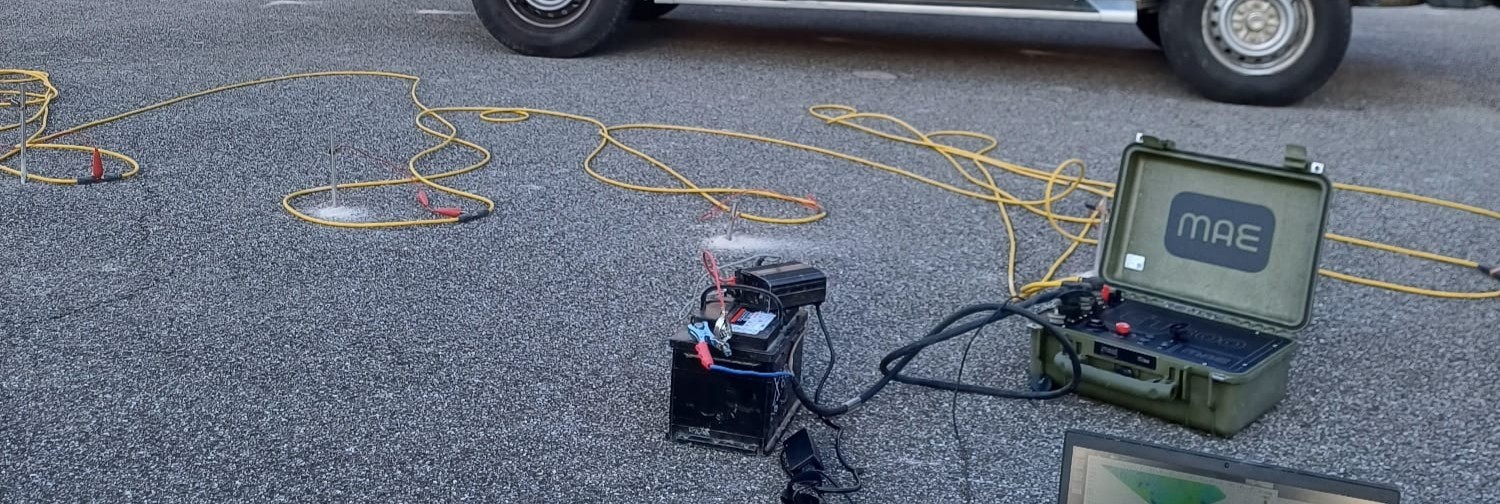
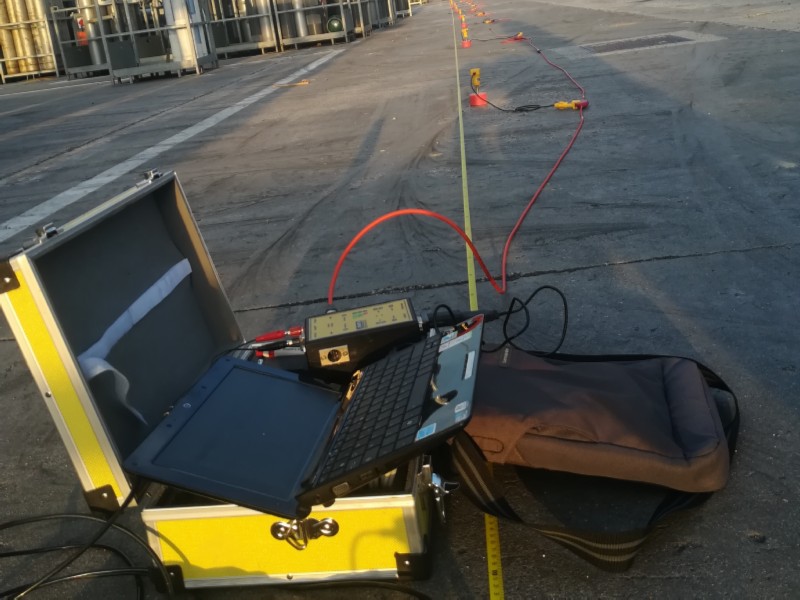
Seismic investigations deal with the study of the propagation of seismic waves through the ground. They are a particularly developed branch of applied geophysics, and they are essential in the design of a building. Current regulations require the verification of the seismic vulnerability of the area being investigated. This verification is essentially based on the calculation of the Vs30 value, i.e. the average velocity at which seismic waves propagate in the first 30 metres of depth.
Our firm is able to carry out the following types of seismic investigation.
The M.A.S.W. (Multichannel Analysis of Surface Waves) test is an investigation technique that allows the determination of the shear-wave velocity (Vs) profile, based on the measurement of surface waves at different sensors placed on the ground surface. It is an active investigation technique (i.e. it is preceded by energising the ground with a hammer blow on the surface). The seismic waves analysed are Rayleigh waves, which change their propagation velocity and frequency depending on the type of soil they encounter along their path. Their study leads to the determination of the Vs30 value.
Refraction and reflection seismics are active investigation techniques that study the propagation of shear waves in the subsurface. In the first case, the waves refracted by the ground are analysed, while in the second the reflected waves are analysed. These tests are again used to establish the Vs30 value, although they have limitations compared with MASW tests when groundwater is present.
The Down-Hole test is an in-hole test (active technique). At the end of a borehole, a PVC pipe is lowered into the hole down to the required depth (typically 30 metres) and made integral with the soil by cementing. A sensor is then lowered inside the pipe; at every metre of depth a hammer blow is performed at the surface and the time taken by the seismic wave to reach the sensor is measured. Similarly to the tests described previously, the elaboration of the Down-Hole test yields the Vs30 value.
The H.V.S.R. (Horizontal to Vertical Spectral Ratio) test is a passive investigation technique in which a device is placed on the ground and "listens" for a defined period of time (typically 15 minutes) to the soil's micro-vibrations from various sources (traffic, atmospheric phenomena, sea-coast wave interaction, etc.). In the subsequent processing phase, the soil's vibration frequency is identified. In addition to the frequency, the Vs30 value is also derived.
Metodologia
Seismic investigations are carried out in compliance with the Italian Technical Standards for Construction (NTC 2018) and the related Explanatory Circular no. 7/2019, with the aim of determining the subsoil category through the Vs30 parameter. MASW tests follow ASTM guidelines and the SESAME project recommendations for multichannel analysis of surface waves. Down-Hole tests are performed in accordance with ASTM D7400, while HVSR measurements follow the SESAME (2004) protocol for the acquisition and processing of the H/V spectral ratio.
Data acquisition is carried out with multichannel digital seismographs and frequency-calibrated geophones. Processing is performed with dedicated software for the inversion of velocity profiles, the determination of dispersion curves and spectral analysis. Results are returned with validated Vs profiles and seismic site classification according to NTC 2018 (categories A-E).
Gallery


Request a Quote
Got a project that requires geognostic investigations or geotechnical consulting? Contact us for a tailored, no-obligation quote.
Contact Us Now